UGC Creator Rates in Africa 2027: What Brands Should Pay
UGC creator rates in Africa range from about ₦50,000 ($37) per video for entry-level vetted creators in Nigeria to ₦500,000 ($370) or more for specialists in finance, tech and health. Most brands working with experienced creators pay ₦100,000 to ₦250,000 ($74 to $185) per video, the typical UGC video price in Nigeria for content that’s ready for paid ads.
TIMA’s campaign data shows that what you pay matters less than who you pay. In our Weltrade campaign, the creator with the strongest category fit drove 70% of all sign-ups, while the creator with the biggest audience drove none. This guide covers UGC rates per video and by country, what pushes the price up, sample budgets, how UGC compares with influencer pricing, and how brands pay creators.
How much do UGC creators charge? UGC rates in naira and dollars
Vetted creators (agency-level, ready for paid ads):
- Entry-level: ₦50,000–₦100,000 ($37–$74)
- Mid-tier: ₦100,000–₦250,000 ($74–$185)
- Specialist (finance, tech, health): ₦250,000–₦500,000+ ($185–$370+)
Open marketplaces: you’ll find beginners listing videos from ₦10,000 to ₦50,000 ($7–$37). These are usually for organic use only, with limited editing and no track record.
The gap comes down to experience, editing, reliability and usage rights. A cheap video you can’t legally run as an ad isn’t cheap.
For comparison, the global median for a UGC video is about $175. Even at the top of the vetted range, African UGC is excellent value for brands.
Creators review their rates often, so treat these as ranges, not fixed prices.
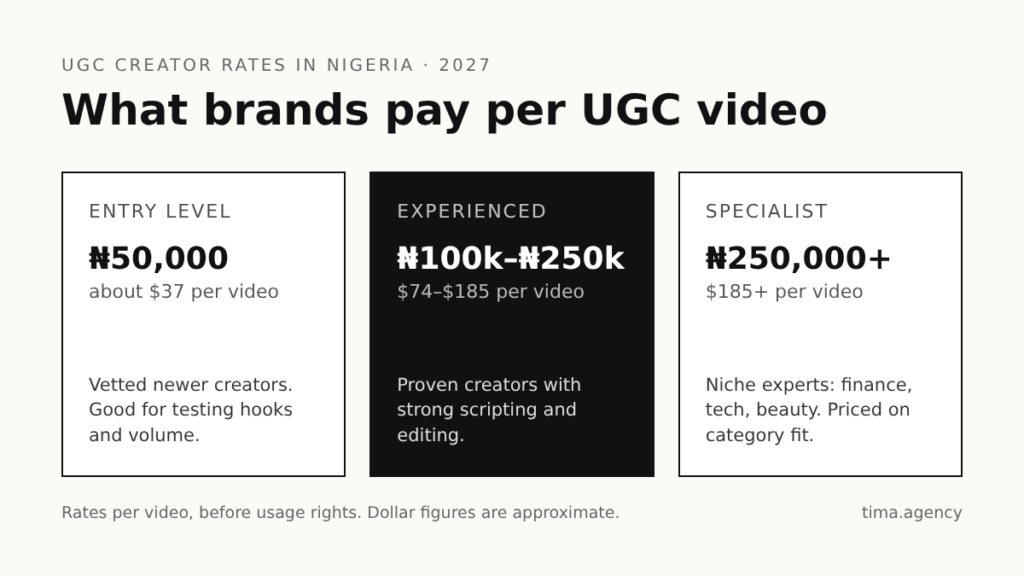
UGC creator rates in Nigeria per video
What each tier gets you
Entry-level (₦50,000–₦100,000 / $37–$74 per video)
These creators have a portfolio and some brand experience, but a shorter track record. Many have strong natural screen presence and good content instincts, and the content can be excellent if you brief clearly. Expect to give more direction and allow for an extra revision round.
Mid-tier (₦100,000–₦250,000 / $74–$185 per video)
This is where most quality UGC work for brands happens. These creators understand briefs, meet deadlines, know how to structure content for conversion, and have results you can check.
Specialist (₦250,000–₦500,000+ / $185–$370+ per video)
These creators bring category expertise and proven ad results on top of production skill. A finance creator who genuinely understands forex, synthetic indices or investment products earns their premium, because the trust their audience places in them turns directly into conversions.
UGC creator rates by country
Nigeria
₦50,000–₦500,000+ per video ($37–$370+) for vetted creators. Marketplace beginners list from ₦10,000.
If you’re wondering how much to pay a UGC creator in Nigeria, start in the mid-tier range and adjust for usage rights and niche.
Ghana
GH₵200–GH₵2,000+ per video ($17–$170+)
Kenya
KSh 3,500–KSh 20,000+ per video ($27–$155+)
South Africa
R500–R5,000+ per video ($30–$300+). Most creators charge around R1,500 ($90), and managed services charge around R2,500 ($150) per video.
Vetted, agency-level creators and paid-ad usage sit at the top of these ranges or above. If you’re running UGC across several African markets, ask each creator to quote in dollars as well as their local currency, so you can compare quotes easily.
Why UGC pricing is different from influencer pricing
Before you look at any number, understand that UGC pricing and influencer pricing are built on completely different foundations.
Influencer rates are driven by audience size. You’re paying for access to a creator’s following: their reach, their platform presence and their distribution. The bigger the audience, the higher the fee.
UGC rates are driven by the content itself. You’re paying for what gets made, not who makes it. A UGC creator with 2,000 followers and a strong portfolio can legitimately charge more than an influencer with 200,000 followers for the same video, because the value is in the asset, not the audience.
This changes the budget conversation for African brands. You’re not buying reach. You’re buying content you own: content you can run as a paid ad, post on your own channels, put on your website or use in email marketing. The creator’s follower count is mostly irrelevant.
What changes the price of a UGC video
- Video length: A 15-second hook-led video costs less than a 60-second explainer. Longer videos take more scripting, filming and editing.
- Editing: A lightly trimmed video costs less than one with captions, transitions, B-roll and text overlays. If you need content that’s ready to run as an ad, expect to pay more for editing.
- Scripting: If you supply the script, the price is lower. If the creator writes the concept, the hooks and the script, you’re paying for strategy as well as filming. If you plan to test ads, ask for several hook variations of the same video, and expect that to cost more.
- Revisions: Most creators include one or two revision rounds in their base rate, and extra rounds cost more. A clear brief upfront is the cheapest way to avoid paying for revisions.
- Usage rights: This is the line item most Nigerian brands miss, and it’s a big one. Paying a creator to make content for organic posting is different from paying for content you can run as a paid ad under your brand’s account. Paid-ad usage typically adds 30–100% to the base fee, and unlimited paid usage adds even more. Whitelisting, where you run ads through the creator’s own account, often adds around 30% of the base fee per month. Always separate the creation fee from the usage fee when you brief creators or work with a UGC agency.
- Raw footage: Some creators charge an extra 30–50% of the base rate for unedited footage. If your team wants to cut its own edits or adapt the content for different formats, agree on this before filming, not after delivery.
- Niche and category: Specialist niches like fintech, SaaS and professional services cost 50–100% more than crowded categories like beauty and lifestyle, where there are plenty of creators. If your brand is in financial services, healthtech or B2B, budget for that premium.
- Exclusivity: If you need a creator to avoid working with your direct competitors for a set period, you’ll pay for it. That’s a reasonable request in categories like banking, telecoms or food delivery, where competitor briefs are common. Put it in the contract and price it in. Don’t assume it.
- Volume and bundles: A single video is the most expensive per unit. When you order three to five videos in one brief, the creator’s setup, research and briefing time is spread across all of them, so the rate per video drops. Creators often discount bundles of five or more videos by around 19%. If you’re planning a UGC-led campaign, brief in batches.
UGC budget for brands: what ₦300,000, ₦1 million and ₦2 million get you
₦300,000–₦1.25 million ($222–$926): an awareness starter pack
Three to five videos for TikTok and Instagram Reels from mid-tier creators, with usage rights for organic posting.
₦500,000–₦2 million+ ($370–$1,481+): conversion-focused creative
Two to four videos built specifically for paid ads, made by specialist creators in your category. This includes full paid usage rights and hook variations. The higher cost per video pays off because UGC is far cheaper to produce than studio creative and often performs better as an ad.
From ₦300,000 per month ($222): always-on UGC
Two creators on retainers starting at about ₦150,000 ($111) per creator per month, producing steady content for your brand channels. It’s a realistic way to get consistent UGC without briefing new creators every campaign.
From ₦3.6 million per year ($2,667): a full year of always-on UGC
The same two-creator retainer, kept running for 12 months. That gives you a constant supply of fresh videos for ads, social media and your website.
What the Weltrade campaign tells us about budget allocation
TIMA’s influencer campaign for Weltrade Nigeria shows how much the way you split a budget affects results.
The campaign used five creators, with a total spend of about ₦14 million ($10,350). The most useful lesson wasn’t the total. It was how differently each creator’s share of the budget turned into results.
- Amokun, the biggest creator by following, received about ₦2.43 million ($1,800) and generated 34,291 views. Awareness was strong, but there were no conversions.
- Grace FX, a finance-focused YouTube creator with a much smaller following, received about ₦6.28 million ($4,650). She drove 117 sign-ups and 11 first-time depositors: 70% of all campaign sign-ups and nearly three-quarters of all first-time deposits.
- Tek had the smallest budget, about ₦1.15 million ($850), and delivered the highest engagement rate (10.04%) and the lowest cost per engagement ($0.92).
Audience relevance and category fit beat raw reach every time. For UGC budgets, put your money behind creators with real category expertise and engaged niche audiences, instead of spreading it evenly by follower count. See how TIMA structured this campaign
UGC creators vs influencers: which one do you need?
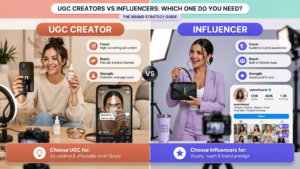
UGC creators vs influencers comparison
UGC is usually cheaper per video than an influencer post because you’re paying for content, not reach. A mid-tier UGC creator might charge ₦100,000–₦250,000 per video, while a macro influencer’s post on their own page can cost millions of naira.
Use UGC creators when you need:
- Ad creative to test and scale on Meta or TikTok
- Content for your own brand channels, website or product pages
- Many variations of the same message, cheaply
- Content you own and can reuse
Use influencers when you need:
- Reach to an audience you don’t have yet
- The credibility of a trusted voice recommending you
- Awareness around a launch or a big moment
- Conversation and social proof on the creator’s own page
Many brands do both: influencers for reach, and UGC creators for the ads that convert the people that reach brings in. For a full breakdown of influencer rates, read our influencer cost guide for Nigeria.
How brands pay UGC creators
Payment models
- Per video: a flat fee for each video. This is the simplest model and the best for testing new creators.
- Bundle or package: a set price for several videos, usually cheaper per video.
- Monthly retainer: a fixed monthly fee for an agreed number of videos. It works best for always-on content.
- Performance bonus: an extra payment if the content hits agreed targets, such as views, sign-ups or sales. It works best alongside a base fee, not instead of one.
Payment terms
A common structure is part payment upfront and the rest on delivery. Agree the terms, the currency and, for dollar fees, the exchange rate in writing before filming starts.
Payment methods
Local creators are usually paid by bank transfer in their own currency. Creators who quote in dollars may ask to be paid into a domiciliary account or through a USD payout service. If you work through an agency, the agency handles creator payments, contracts and usage rights in one place.
What brands get wrong about UGC budgets
The most common mistake is treating UGC as cheap content. It shouldn’t be.
UGC pays off over time because you own content you can reuse across paid ads, organic posts, email and sales material. One well-made UGC video that works as a Meta or TikTok ad can return far more than it cost to make, but only if it was made well. That means briefing the right creator, paying a rate that attracts serious professionals, and paying for usage rights upfront.
Brands that squeeze creator rates tend to get content that looks squeezed. Viewers can tell, and when authenticity is the whole point of UGC, that kills the content.
The second mistake is ignoring usage rights. Some Nigerian brands commission UGC and run it as a paid ad without the creator’s knowledge or agreement, which creates legal and reputational risk. A UGC agency builds rights and licensing into every contract, which protects both the brand and the creator.
Working with a UGC agency vs managing creators yourself
You can get UGC by managing creators yourself or by working through a UGC agency like TIMA.
Managing creators directly looks cheaper on paper, because there’s no agency fee. But the hidden costs add up fast: finding and vetting creators, briefing them, chasing revisions, negotiating usage rights, paying several creators, and then doing it all again for the next campaign.
An agency takes all of that on. The fee covers the operational work and the matching: knowing which creators will actually perform for your brief, category and audience. For brands running UGC at scale, or needing content that performs as paid ads, the agency model usually gets more results per naira. Read more in What Is a UGC Agency and Why Nigerian Brands Need One.
The bottom line
There’s no single right amount for an African brand to spend on UGC. But there is a right way to decide it: budget by objective, pay for category expertise over follower count, price usage rights separately and upfront, and order videos in batches rather than one at a time.
The Nigerian brands getting the most from UGC treat it as a media investment, not a creative expense. That framing changes every decision that follows, from who you brief to what you pay to how you measure success. For the bigger picture on where UGC pricing is heading, read The Changing Economics of UGC.
FAQ
What is the UGC video price in Nigeria?
A UGC video from a vetted creator in Nigeria costs about ₦50,000 to ₦500,000 or more ($37 to $370+), depending on experience, niche, editing and usage rights. Most brands working with experienced creators pay ₦100,000 to ₦250,000 ($74 to $185) per video. Beginners on open marketplaces list videos from about ₦10,000.
How much should brands budget for UGC?
Budget by objective. An awareness pack of three to five videos costs about ₦300,000 to ₦1.25 million ($222 to $926). Conversion-focused ad creative costs about ₦500,000 to ₦2 million or more ($370 to $1,481+). An always-on retainer with two creators starts at about ₦300,000 ($222) per month.
Do UGC creators charge for usage rights?
Yes. The base fee usually covers creating the content and organic use. Running it as a paid ad, using it for longer or whitelisting it through the creator’s account all cost extra. Paid-ad usage typically adds 30–100% to the base fee.
Plan your UGC budget with TIMA
Planning a UGC campaign in Nigeria or across Africa? TIMA matches you with vetted creators who know your category, builds usage rights into every contract, and structures your budget around your objective.






[…] influencer marketing pays creators for content, a flat fee for a Reel, a TikTok, a YouTube integration. The creator delivers the content. The […]